Key takeaways
- SEO, PPC, and social media marketing are all getting harder and more expensive
- There are still real opportunities in each discipline of digital marketing in 2026
- Build your authority and reputation to help with search, AI, and humans
- Improve your website to make it easy to book with you
- Call your enquirers within 5 minutes to improve conversion rates by >21x
- Focus on creating great relationships with your current and ex-patients
What Happened in Healthcare Digital Marketing in 2025?
It’s 2026, and this is getting hard. 2025 was not a great time for smaller clinics that drive their new patient volume primarily via digital marketing.
There were some winners, leaders who cracked the social media code, clinics who invested in brand, and practices with strong lead engagement and re-engagement teams.
Top Takes from Medical Marketing Leaders
I asked leaders in healthcare digital marketing on LinkedIn what their most controversial takes on changes to make in 2026 were:

The personal brand bandwagon who are convinced that creating videos alone will 10x their clinic growth will fade out and eventually come back to paid ads and SEO.

Spicy take: people will not be impressed by reviews or single pieces of content. They want to see the real people who are doing the work behind the content and actually deliver the service. They want to get to know them for a few months or even years before they trust them. And even interact with them. If you have no history of helpful content, you better start creating it with the intention of actually helping people. It’s better for humanity and you will grow a community with people that help each other too.

- The importance of EEAT will continue to be massively exaggerated as a ranking factor.
- Broad medical information will continue to get the AIO treatment (the money will be in the long tail).
- Practices that have a USP and understand their target patients best will begin to win as AI surfaces more niche specific care providers
- Video will become even more important.
- ChatGPT will falter and stall and Google will begin to crush them.
- Google will continue to stuff the SERPs, crowding out organic listings and paving the way for a paid (ad free) version of search.
- “Average” will become the new “bad”
- Parasite SEO and DPR will become more important.

My spicy take is that most marketing agencies in the mental health care world do not offer updated strategies. They’re doing the same thing as they did in the mid 2010s, and with AI, that simply doesn’t cut it anymore. Looking forward to reading!
.DqEYPU9p.jpg)
Here’s my spicy 2026 take for healthcare marketing: By the end of 2026, “healthcare marketing agencies” that only do ads/content will be effectively dead. The winners will be fully embedded profit partners who own the patient journey and get paid on outcomes, not retainers. How’s that for spicy 🌶️

Here’s a subjectively spicy one: Before getting too focused on LLMs, benchmark what proportion of your customers are actually using them.
The number will be demographic/service dependent.
Also, what Geoff Meakin said: Google will win.

Chat GPT is helping founders/ directors to identify cheap and “quick buck” marketing cowboys using strategies such as “5000 backlinks for £20” and explaining how this can harm your business. As Doctors we have no marketing experience or training so often get conned. I run my marketing proposals by AI and it gives great insights into what is realistic and what is fake and what is not evidence based. Only professional honest marketing guys like yourself will survive.
There are plenty of people I’d recommend following on LinkedIn, who are talking on the topics I’ll cover below in more depth:
- Darren Shaw, my favourite local SEO creator
- Jared Aron, patient re-engagement
- Liam Welch, lead nurture & outreach
- Martini Siu, thought leadership for physicians
Oh, and you can also follow me for the latest info on medical SEO, AI, and websites.
My overall message for digital marketing in 2026 is that things have gotten harder:
| What’s changed in 2025 | What it means for clinics | What to do in 2026 |
|---|---|---|
| More zero-click searches (AI Overviews, richer search engine result pages, more LLM use) | Fewer website clicks, weaker attribution | Build authority off-site (reviews, PR), and make on-site conversion frictionless |
| Organic CTR is down when AI overviews appear | Informational SEO drives less traffic and fewer clicks | Shift content toward local, commercial intent: service pages, GBP, “why us”, proof, process |
| Paid search is more expensive | Bigger players can outspend you | Tighten conversion, improve lead handling, and test paid social where it fits |
| Organic social reach is declining | Posting more doesn’t equal growth | Create fewer, better “primary assets” (video-first), then repurpose across channels |
| Trust signals & authority matter more than ever | You need to build up social proof on your website, and off it. | Systemise review generation, showcase outcomes, and build a credible media profile |
| Convenience is now a competitive advantage | Patients choose the easiest clinic to book with | Add multiple ways to book. Call leads within 5 minutes, then if no response, follow up consistently across 2-3 channels |
| More competition across more channels | Marketing requires focus, not scattered effort | Pick 1-2 priorities per quarter and execute properly (not everything at once) |
| Customer long term value is more important in context of increased acquisition cost | Retention and reactivation reduce ad dependence | Improve expectation alignment, personalise communication, and run light re-engagement |
Clicks are Down & Cost is Up
As Google continues to experiment with more AI overviews & ads, and users spend more time researching via AI, more and more searches for healthcare treatment end with zero clicks through to clinic websites. Seer Interactive showed that organic CTR (click-through rate) drops by 61% when an AI overview (AIO) is present. In a November study, Ahrefs found that AIOs were present in 43% of health queries (the 2nd-highest category), and more like 99.9% if those queries were seeking information.
This doesn’t mean fewer people searching (searches actually reached a record high in 2025, and 95% of ChatGPT users still rely on Google), but instead means we’re blind to much of how patients search and find attribution more complex. In AIOs, people are getting their answers to informational queries without giving you the chance to show your wares. It’s the same in LLMs, but large, high authority private health centres also have more budget for PR and are more likely to be cited as “the best X clinic near you” within AI.
We’re also seeing increased cost with Google Ads and other paid surfaces. Paid ads cost are up with a 9.4% rise in CPC for physicians & surgeons in 2025 on Google. Again, bigger businesses are at an advantage, with bigger budgets and economies of scale (bigger budget, more ads, in-house ad managers and creatives).
Social Organic Reach is Down
With algorithm shifts across social platforms (Social Insider found a 12% decrease in YoY Instagram reach), we’re seeing less reach with each post, and traditional “cheaper” (read: lower effort) social media marketing is just not cutting through. Here, single-provider clinics have an advantage through the ability to connect more personally with potential patients, but my experience is that high follower count doesn’t necessarily translate to patient volume if your core message on social isn’t aligned with your practice.
There are more marketing surfaces to spread your efforts across than ever, fewer low-hanging fruit available, and more competition. ROI is lower, budgets are higher, and decisions are more difficult.
It’s also harder to prove the efficacy of your marketing efforts. Patients spend weeks researching their symptoms and doctors that can help before they ever make their first click or call. How do you track those touchpoints within strict privacy laws (and even stricter standards around remarketing or health targeting in advertising)?
Was it your ad that drove the click?
Your informational article on the topic?
Your reel from 3 weeks ago?
Or the review from 2024 from someone suffering from the same condition?
AI isn’t a Cheatcode
Through 2025, we’ve seen an explosion in AI advances, corporate layoffs, and AI slop starting to dominate social media. Businesses expected this to cut costs and increase efficiency, and while we can do more with AI, but it’s not a silver bullet.
I’ve seen too many “I replaced my whole marketing team with this 820 node n8n automation, you can too if you just like my post, comment ‘GET STUFF’, and tell your neighbour about my AI-enablement services” in 2025.
I’d file it under the same cheap tricks you see across marketing (the cheap tricks that make the public hate marketers), including:
- Creating a “best of” list and putting yourself at the top
- Publishing “research” that consists of you making up stats to rank in LLMs (the bane of my existence whilst writing this blog… seriously, you just add numbers without a source, and it works??)
- Cherry-picking stats to show how great your service is (want me to get your clinic 2000% more traffic? I can do it within 3 months, but you won’t see any revenue coming in from it)
- Winning an award that you just paid to “win.”
- Engagement pods
And when you try cheap marketing tricks, people notice.
Consumers can now detect AI-generated content at least half the time, and while 86.5% of top-ranking pages have some form of gen-AI content, websites using AI only grew 5% faster than those without. AI content produced at scale, or without human oversight or careful strategy, fails to capture attention, connect with people, and drive results. Perceptions of brands using AI-generated copy are 20% more likely to view the brand as lazy or untrustworthy.
So, What Can I Do to Prepare in 2026?
Ok, enough of the negativity.
SEO isn’t dead, paid isn’t dead, blogging isn’t dead (sort of).
Nothing is dead, apart from your “ultimate guide to Knee surgery” that starts with “h2: what is surgery”.
But standards are higher everywhere. Digital marketing is no longer the thing you farm out to your cousin’s friend for £500, nor is it something you can keep out of involvement with.
To win at digital marketing in 2025, your marketing team needs your help. We need your expertise to genuinely add something of value to the content we make. We need your help to craft effective ideal client profiles, core messages, and USPs. We may even need you to nip onto a video or two.
I’d suggest that you choose 1 or 2 priorities per quarter to focus your efforts on, to help squeeze every marketing dollar you have available in your bucket.
If I were a clinic owner, I’d focus my attention on these pillars in 2026:
- Reputation: build a good service, treat patients well, get mentioned on 3rd party media (news, podcast, social) as a source of truth in your primary treatment area. Ask for reviews!!
- Convenience: make it super easy to book with you, whether that’s through online booking, multiple options (call/sms/chatbot/whatsapp/email), or simply through having a funnel that’s easy to follow as a patient.
- Relationships: contact new leads quickly, ensure they know that you’re going to get back to them, and then nurture relationships with current patients or those you wish to re-engage.
Of course, you also need to get your foundations right. None of these matters if you don’t have a place to convert these patients, ideally a website that is built to drive the right traffic through ads, SEO, and AEO (getting recommended in AI answers), and then convert users into patients.
You’ll also notice that I don’t mention GEO/AEO/LLMO specifically here. Online hustle-bros may try to convince you that SEO is dead, everyone uses ChatGPT for everything, and you should pay them some money, but they are lying. AI search traffic accounts for <5% currently, and while that is going to increase with AI mode likely taking over as Google’s default mode, you’d be losing money if you switched focus at this stage. There are plenty (if not most) SEO practices that will help with AI visibility, so keep your eyes on this first.
Here’s a summary of my suggestions:
| Initiative | Ease of Implementation | Impact on Revenue & Growth | Strategic Guidance |
|---|---|---|---|
| Call new enquiries within 5 minutes | Very High | Very High | Highest ROI lever available. Process > tools. |
| Clear pre-visit communication & expectation setting | High | Very High | Prevents negative reviews and drop-off without changing care quality. |
| Review generation (Google + 1-2 platforms) | High | High | Compounds SEO, AI visibility, and trust. Consistency matters more than volume. |
| Website Conversion Rate Optimisation (CRO) basics (clear CTAs, fewer form fields) | Medium | High | Essential as traffic declines and intent increases. |
| Online booking & chatbot (24/7 lead capture) | Medium | High | Strong advantage for out-of-hours searches and competitive local markets. |
| Local SEO (GBP, service pages, local citations) | Medium | High | Higher impact than generic blogging in 2026. |
| Digital PR & media mentions | Medium | Medium-High | Builds real authority for humans and AI systems. |
| Email nurture (non-promotional, value-led) | Medium | Medium | Works when tied to real patient conversations, not campaigns. |
| Content repurposing (video-first assets) | Low-Medium | Medium | Only valuable when starting from strong primary content. |
| Paid social ads (experimental) | Low-Medium | Medium | Useful test channel once fundamentals are solid. |
| Local partnerships & in-person collaborations | Medium | Medium-High | Underused, high-trust channel that compounds referrals over time. |
| Organic social posting | Low | Low-Medium | Supports brand, rarely a direct growth driver alone. |
| AI / GEO / AEO optimisation (standalone) | Low | Low (for now) | Hygiene work only. Do not prioritise over fundamentals. |
Let’s go through these, as well as some tips on where else you can put your focus, depending on context and opportunities.
Opportunity 1: Build Reputation & Authority
In 2026, reputation and authority are everything. People trust you more when you have authentic testimonials and social proof that back up your credentials. LLMs (naively) believe you are better if you can demonstrate results to back up your claims. You actually need to provide a good service that patients like, and then you need to demonstrate this on and off your website.
You’ll hear a tonne of stats that talk about Reddit and Quora becoming the biggest sources of AI citations, but I’d argue strongly that spamming these forums with positive brand sentiment is:
- A: a cheap marketing trick
- B: completely transparent to any genuine Reddit user, risking being exposed as the spammer that you are
- and C: way too difficult to do in any genuine manner for a bricks-and-mortar practice
Instead, I’d focus on building your reputation as the best at what you do in a few ways:
Reviews
Great for: SEO, Local SEO, AEO, Conversion rates
Reviews are SO important in 2026 for clinics, for a few reasons:
- They are great to get local visibility (Google map pack). Once you’ve optimised your Google Business Profile, they are the 2nd most important factor according to the Whitespark 2026 local ranking factors.
- AI loves them as a source. Brand sentiment matters hugely in being recommended in AI search, so getting good reviews across a variety of different review sites is very helpful.
- Patients trust you more if they can see genuine reviews. I won’t even try to pick a stat here. There are so many that show that reviews hugely impact consumer behaviour.
You can also see review sites like Yelp gaming the system by programmatically creating “10 best X” lists, which LLMs love when a user’s query requires web search, so getting your Yelp reviews into the top 10 in your area could be key to appearing in AI overviews and LLMs as a recommendation.
In terms of getting more reviews, I have a few recommendations.
First, start asking.
We’re all busy and focused on our own lives. The required motivation to leave a good review vs a bad one is night and day. To get good reviews without asking, you need to give a truly exceptional experience. To get a bad one, you just need to slightly inconvenience people. I get that it’s a sensitive topic, you don’t like getting bad reviews, but they’re going to come in anyway, in a much greater proportion, if you don’t ask anybody. People don’t trust 5-star averages anyway; the ideal rating is between 4.2 and 4.5.
However, you gotta ask the right way. I’d suggest:
- Keep a stack of QR code business cards that link to your Google Business Profile review URL (here’s an easy tool for that), and hand them out to patients after you’ve seen them. Something that is worth keeping for them (e.g. keeping your clinic details on there so they keep it in their purse/wallet) makes this an even better idea. A personal appeal as you hand it to them (“we’re trying to reach people in similar situations to you and reviews really help”) goes a long way.
- Send out emails and SMSs after a visit. Make it SUPER easy and convenient. Ideally, you can hook your EHR up to a review generator tool like Birdeye to do this, but doing it manually (esp with a personal touch or from your doctor’s email) works great. It even looks like sending 9-14 after a visit may work best. Do note that plenty of commercial email goes unopened, hence why I’d suggest SMS as the primary method, keeping in mind GDPR preferences
- Get a QR code poster or an NFC review card so that your reception team can just ask them to quickly tap on their way out. I’d be careful not to make it seem like they owe you a review. Asking with gratitude is the way forward
Recent local ranking factors show that, for Google, getting reviews regularly is more important than numbers alone. If you can get reviews more frequently than your competition, you can out-rank them even if they have 5x more in total than you.
I’d also suggest diversifying your review platforms once you’ve collected enough via Google. Google is still king here for in-person businesses, because getting your business profile in the “local map pack” is great for getting more leads, but AI is looking all over for reviews before giving brand recommendations. Look at the main review sites in your country, get 5-10 reviews in each so that it doesn’t look so sparse, then focus on Google + 1-2 (e.g. Google + Doctify, or Google + Yelp) when asking for reviews.
Digital PR
Great for: SEO, AEO, Brand
In terms of both SEO and AI, digital PR is emerging as an excellent way to build links to your site and get cited as an expert in your field. You can see from my client’s media profile that this is something I heavily lean on. Getting spammy backlinks and mentions on websites that have been created with the sole purpose of selling backlinks is not a good trust signal for users or search engines. On the flip side, being cited as an expert in your field in publications like Time, The Independent, and WebMD is a fantastic signal.
However, this can be a lot of work, and you have to get it right. Here’s how I’d approach it as a clinic leader.
Step 1: Create a media profile
On your website, update your about page to show off the credentials and accolades that you have earned. This can include your training, specialisations, awards, media mentions, leadership roles, basically anything that shows off your expertise.
It might feel quite odd to be this self-promotional, but think about some of the charlatans putting themselves out there as “health experts” on the internet. Wouldn’t you rather be steering the conversations than them? Promote yourself, queen. The world needs you to.
Use AI to condense this down into a short bio and an “elevator pitch” as to why you would be great at answering a query in your field.
Step 2: Make accounts on PR platforms like Qwoted (my favourite), HARO, and Featured
Use the info (as well as a nice headshot) to create this, and set yourself up for email notifications for when a journalist needs help in your subject area.
Step 3: Pitch to relevant requests
You may only see 2-3 a month that are ideal for your background. It may be more like 10-15 that are less specific to you. Depending on the time available to you, try to answer as many as you can. The key thing here is time. Getting your response back in the first few hours (before 5-10 other people get in there) means your rate of being quoted is much higher.
When pitching, you need to give a bit of background, show off your relevant credentials, and mention why you’d be great in this specific case.
An example of a pitch I use:
“Hi X,
This would be perfect for me. I am a [role + speciality] who specialise in [sub-speciality, ideally the topic at hand].
I’ve worked with a number of journalists, such as at [name a few if you have quotes already], to give quotes on their stories. [something specific to the actual query that helps position you as the expert, e.g. “I’ve actually spoken at the AAOS conference on hip pain in menopause, so would be able to offer specific insights on this”].”
Sometimes you’ll be asked for your responses up front. If this is the case, I’d only put significant effort in if you’ve been quick off the mark. If it’s been more than 2-3 hours, I’d keep it short and sweet, as chances are someone else got in there first.
If you do this right, you can start getting authentic backlinks and media mentions that you can then show off online, and that will greatly help your personal brand and website authority.
Brand Building
Great for: Brand trust, authority, long-term demand
I’m not a brand consultant or a social media growth expert, and I don’t think most clinics need to “build a personal brand” in the influencer sense, but if this is something that you have a natural talent for, it can do wonders.
When a patient, search engine, or LLM tries to answer the question “Is this doctor legit?”, it’s helpful if you exist beyond your own website.
A few places this tends to work well for clinics:
Podcasts and talks
Being a guest on relevant podcasts, panels, or local events positions you as an expert. You don’t need huge audiences. Niche, credible audiences matter far more than download counts. These appearances often get transcribed, quoted, and linked to, which helps with both human trust and AI discovery.
Professional collaborations
Collaborating with other respected clinicians, gyms, wellness providers, or local businesses can create real-world credibility that translates online. These often lead to natural mentions, backlinks, and referrals without feeling promotional.
Consistent social presence
Even if thought leadership isn’t a goal of yours, you can still help build up your reputation by having some sort of social presence. When someone is researching you, seeing signs of life and professionalism builds confidence. This can be as simple as sharing clinic updates, short educational posts, or reposting media features and reviews.
Video content
Ok, this isn’t for everyone. But with the growth of short-form video content, AI grabbing answers from YouTube, and more patients self-educating before they ever book an appointment, there is real upside to clearly explaining what you know online.
Think of it this way: if you can record 10x 30-second clips on different conditions, you can push this out to YouTube/TikTok, use it as ad creative, and embed it within your website to connect better and convert users into patients.
If you can do this consistently and find an angle that connects (think menopause, longevity, fertility), you can even build a practice out of doing just this.
Opportunity 2: Make Things Convenient
This is all about CRO. With more “zero click” searches, less traffic on your website, and an audience with the attention span of a goldfish, turning the eyeballs you do get into paying customers is something I’d focus on in 2026.
There are roughly 3 buckets of users landing on your website:
- International or non-local users getting health information from your articles: potentially useful if you’re building a followership or personal brand, or have a product you can offer, but otherwise not something you can tie to revenue.
- Local users who are looking for information or window shopping: these people aren’t ready to book, but they are important for future conversions. Make a good first impression: fast, professional site with useful information and plenty of social proof.
- Local users ready to book: this is the audience you need to optimise for primarily. They will pay your bills. Use the techniques below to turn eyeballs into revenue.
(This doesn’t account for the significant amount of website traffic that’s actually internet bots gathering information for search engines and LLMs.)
Here are a few ways to improve your conversion rate:
Website Conversion Rate Optimisation
With traffic getting worse, you only have about 15 seconds to prove to users that your website is worth continuing on with. There are a few key ways you can do this.
The first is to make your site load fast and look good. In 2026, you should be thinking about mobile users first, most people browse for local services on mobile, and Google also reads your site mobile-first. If you’ve paid $1000 to someone on Fiverr to make your site, chances are that it’s a WordPress site designed on Elementor, with 20+ plugins to fulfil all your requests. All of this slows down your site (even if it looks pretty). You can speed this up by cutting down unnecessary plugins, using performance plugins (be careful, as these can break functionality), and choosing a good host +/- CDN. I recommend Krystal for the UK and Rocket.net for the US, plus Cloudflare CDN.
Check out your website speed on Google’s Pagespeed Insights tool.
The next key is to make sure that all of your key information is easy to find: opening times, phone number, email, insurance info, parking/accessibility information. Keeping your key info behind a phone call or contact form doesn’t cut it in 2026, you need to be as transparent as you can to help users and feed info to AI. If you don’t include it, AI will just make it up for users searching. Navigation via your header and footer menus is also important. Think about how users in different circumstances (looking for info, window shopping, looking to book) will want to interact with your site.
You can also optimise your CRO in more detail by playing with your buttons, forms, and calls to action (CTAs). You should make it easy when someone who is at a point where they may get in touch with you, to do so. Here are some quick wins:
- Include buttons that immediately open the phone app, or direct people right to your booking forms, to get higher conversion rates.
- Ensure your forms have as few fields as possible, each additional field lowers completion rate (though adding friction is the right call if you’re getting low-quality leads).
- Make your calls to action specific (e.g. “Book with Dr Smith”, not “Contact Us”). This can raise your conversion rate by 161%.
The key here is to find a way to test it. Make sure you’re actually tracking your conversion rate with tools like Google Tag Manager, and A/B test changes across different pages to see if a change helps or hurts conversions. You can also use tools like Microsoft Clarity to get free heatmaps and recordings (though be clear in your GDPR statements when using this!).
You could also play about with CRO techniques like pop-ups, but beware: you might improve the overall conversion rate, but at the cost of damaging your brand.
Lead Capture
This is really another form of CRO. In addition to simply optimising your website, you can go one step further by implementing technology within your site, such as online booking forms, chatbots, and AI receptionists.
Getting HIPAA/GDPR-compliant booking widgets that actually integrate with your Electronic Health Record can be expensive, but it may be worth it if you already have the relevant traffic on your site. People are generally shopping around, looking at 4-5 different doctors, so having your practice offer the easiest booking solution can help people end their search, especially out of hours.
The hidden benefit of this, particularly if you can do this in combination with AI or outsourced reception teams that can answer 24/7, is that you can effectively extend your reception opening hours. This is important given two things:
- 43% of booking enquiries occur outside of working hours
- Google heavily prioritises clinics that are open at the time of the enquiry
Here’s an example: December 18th (practice open) and December 25th (practice closed) local ranking results for the same practice:
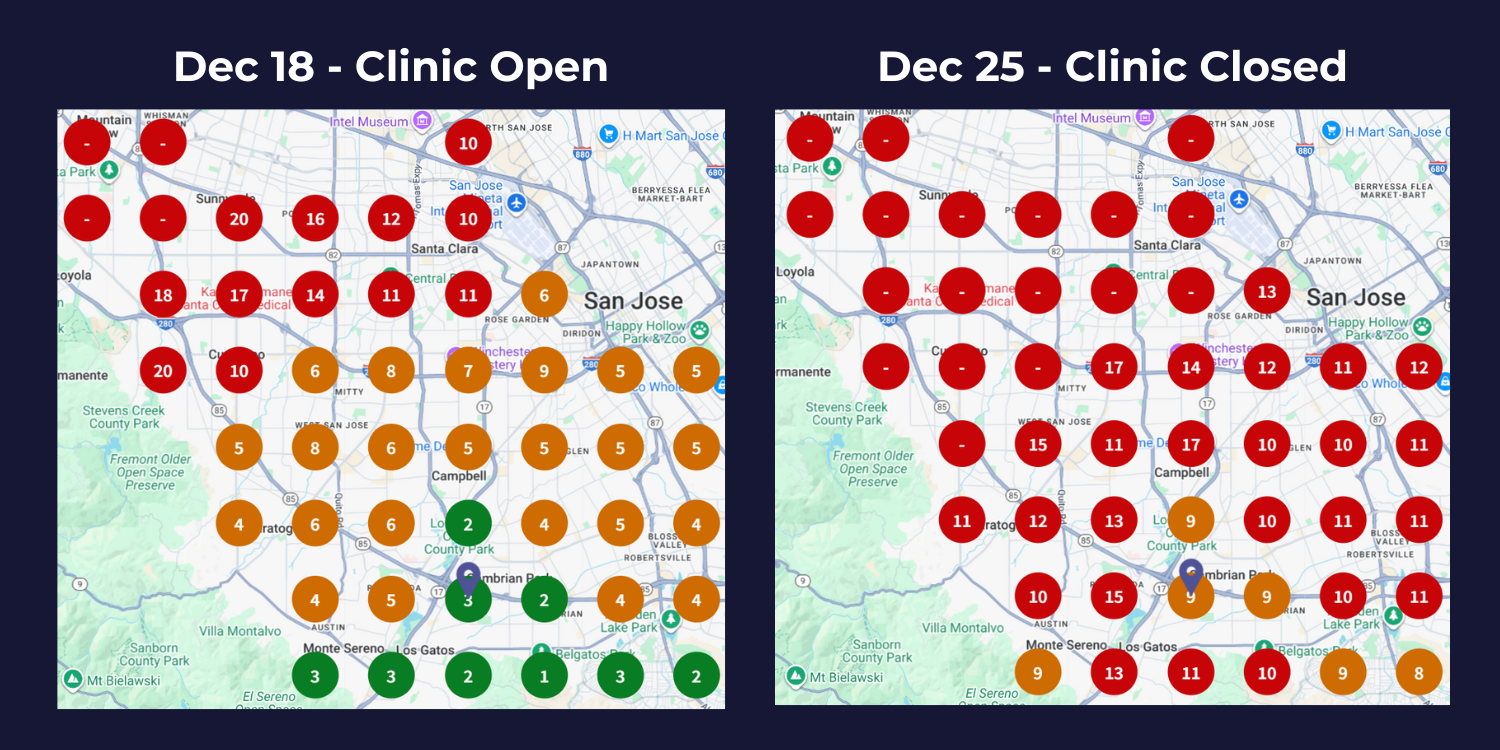
So, if a patient is searching for a doctor after work, at 7pm, there’s a huge opportunity for practices that are able to report being open at that time. Be careful with this (Google can and will monitor how often you actually answer the phone at this time), but if your booking team is actually available, you can take advantage of a huge ranking factor for commercial searches.
The final thing I’d highly recommend here is a chatbot. I actually find website chatbots quite annoying, not quite enough for me to dislike a brand, but enough to feel hesitant, as some of you may be. That said, I’ve seen huge results from implementing chatbots on websites. Having a “patient concierge” type bot that can quickly turn visitors into enquiries genuinely makes a big difference, with 60% of bookings from my clients coming by way of these chatbots.
I’d recommend something like EnquiryBot, which hooks up nicely with Lead Management software Boxly. This combo led to a huge increase in revenue for my orthopaedic practice client, more than any other intervention we’ve made.
Lead Nurture
This is what happens after someone has made an enquiry, and you need to turn them into a patient. It’s not uncommon for patients to send 4-5 enquiry forms to see who will get back to them first.
My first suggestion is to make sure they know that their message has been received. A simple “we got your contact form, here’s what happens next” helps to set expectations and improve certainty that you will actually get back in touch. Use software to automatically send an email (and ideally an SMS) to tell your enquirer that you have their message, and when they can expect a reply or call.
Secondly, and this is a bugbear of mine and one of Tiarnan McKeever’s missions on LinkedIn in 2025, is to call your patients back quickly. Calling enquirers back within 5 minutes rather than 30 minutes improves your conversion rate by 21x.
Let me say that again, to help it sink in: your chances of qualifying a lead if you wait an additional 25 minutes are 21 times lower.
The next thing to consider is how you follow up on these leads. People are busy, phone calls come at inconvenient times, and it’s easy to get distracted. Follow up with your leads at least 5 times, using at least 3 platforms (e.g. phone, email, SMS). Boost Patients are doing great work around this.
I would suggest that improving call response times, following up on leads, and making sure your phone lines are actually open and responsive should be your number 1 priority in 2026.
Finally, make sure you have more than one method to get in touch with you. Over 60% of people want to be able to book online, particularly in younger generations, but being able to contact via WhatsApp, SMS, or email is a close second for those who don’t feel comfortable on the phone.
Opportunity 3: Nurture Relationships
If Opportunity 1/2 is about reducing Client Acquisition Cost (CAC), this is more about improving customer long-term value (CLTV). This is one of the biggest opportunities in the age of AI and a yearning for authentic interactions, but it is also the one I have the least day-to-day involvement in, so I’ll keep it short.
There was a huge trend in 2025 of patients taking their health into their own hands and prioritising personalised medicine (think personalised supplementation, home testing, longevity medicine), where interactions with private health can move from seeing a patient and treating them, to having a long-term (and more mutually profitable) relationship.
Right now, you may find that patients come in once, have a decent experience, then disappear. Or worse, they get good care but never fully understand what else the clinic could have helped them with.
Strong relationships do three things:
- Increase lifetime value without feeling salesy
- Increase word-of-mouth and referrals
- Reduce marketing dependency over time (hello, constantly increasing PPC budget)
None of this requires manipulation. It requires consistency, clarity, and follow-through.
Personalisation
Personalised care isn’t about using someone’s first name in an email. This is nice to do, but patients can see straight through it (as they can with AI flows that don’t have a human in the loop).
Real personalisation is behavioural: remembering context, acknowledging how close someone is to booking, and showing that you actually paid attention.
At a human level, this looks like:
- Referencing why they originally came to you
- Remembering previous frustrations, goals, or constraints
- Not making patients re-explain themselves at every touchpoint
Clinics that do this well feel personal without being overbearing. In 2026, there’s also a systems layer to this. Increased personalisation now comes from better intake data that’s actually used, clear segmentation of patients by goals and treatment paths, and communication that feels personal.
You already have all this data, but now it’s time to use it and build communication pathways and opportunities to increase CLTV. This could be time-intensive, particularly for single-provider practices, but if you’ve already played with your other growth levers, it could be worthwhile.
Good Communication
In my experience, for clinics that are providing a high standard of care, the single biggest driver of negative reviews and poor experiences is a lack of communication leading to a mismatch of patient expectations.
Think of a patient expecting to turn up for a 20-minute treatment, but actually needing an hour consult, followed by in-house tests, and finally the injection that signifies. In this case, you’re providing an exceptional service that qualifies the patient for the best possible treatment for them, but the patient just sees that they had to cancel their coffee date or apologise to their boss for missing the afternoon. Bam. 1-star review, negative word of mouth, opportunity for a longer-term relationship missed.
Now, on the other hand, if your booking communication (email, phone, in-person) is clear and explains the benefits that they are getting, you’re suddenly giving the patient exactly what they expected and more. The appointment hasn’t changed. The clinical quality hasn’t changed. The only thing that’s changed is expectation alignment. Instead of the patient thinking “this took longer than I was told”, they think “this was thorough”.
The same goes for costs. People hate surprises, and too often I’ve seen that clinics hold back this info until after it’s too late, losing a customer and leading to negative feedback. Being clear and transparent with patients, and communicating in a way that emphasises benefits and positives, heads off this risk.
Clear pre-visit communication, realistic timeframes, and simple explanations of why each step exists protect the relationship before it ever gets tested. They prevent resentment from building, leading later to a review, a refund request, or a decision not to return.
Re-Engagement
I’ll be quick on this, as it’s not something I do.
Patients drop off, and may have never needed more than a single appointment. But chances are, they’ll need you again, whether that’s in a year or a decade.
Light, respectful re-engagement via email, phone, or text can bring back:
- Patients who benefited but got busy
- Leads who weren’t ready at the time
- People who would return if reminded of why they came in the first place
This is a deep topic on its own, and it’s evolving fast. If you want to go deeper here, follow Jared Aron on LinkedIn. He’s putting out some of the clearest content on patient reactivation without burning trust.
Other Opportunities
So we’re now verging on content that’s telling you should spend hundreds of hours a quarter on your own marketing and patient acquisition (something you probably shouldn’t do, though you can always pay us to do it for you ;)). Again, I’d like to emphasise that these opportunities depend on where you’re at with your current marketing, sales, and communication systems.
That said, I’ve missed out a tonne of opportunities that might be right for you, depending on your context and goals for 2026. Let’s go through some of the biggest changes that I’m seeing:
Content repurposing, try video content:
Taking a crappy blog and turning it into crappy socials and newsletters is out. Instead, create resources that are naturally repurposable. Think a webinar that you can turn into a video series, or short form content you can use for social, YouTube, paid social, and on-page engagement improvers for your website.
Paid Ads, experiment with social:
With Google’s PPC getting more expensive, you should take a look at social ads. This could be a fantastic way to reach an audience that you never would have had the opportunity to talk to, if you’re comfortable getting in front of a camera.
SEO, focus on local:
Stop blogging like it’s 2016, you’re just going to get junk traffic. Instead, focus on local SEO: Get listed on every industry-relevant website, do more sponsorship/collaboration with your local community, have clear service pages on every service you offer, optimise your Google Business Profile, and localise your website content.
AI Optimisation/GEO/AEO, start gently:
Something to think about in 2026, but not actually going to drive any significant traffic. Be clear on who you are and what you do, both on your website, on 3rd party websites (like business citations and review sites), and potentially press releases. Consider investing in digital PR, your social media/YouTube, or collaborating with others who have higher visibility. Structured data is still a maybe at this point. DO NOT SPAM REDDIT, PLEASE.
Email, avoid spamming your audience:
Spammy self-promotional emails lead to unsubscribes and worsening open rates. Instead, offer genuine value and build community. Think about the top things that you actually communicate with patients in your appointments, and write this up as useful emails that can help the majority of your patients. Include your genuine voice, clinic updates, and gentle CTAs. AI-generated promotional slop won’t cut it here.
In-person Marketing:
Previously out of fashion, but increasingly somewhere you can actually make an impact. I’ve seen several good examples of this, such as sponsored collabs with running clubs and Padel courts for orthopaedic clinics, or networking with colleagues who may genuinely refer patients to you.
Finally, I wouldn’t want you to do this all by yourself. Here’s a run-down on what’s doing yourself vs giving to a third party.
| Channel | Best Run In-House | Best Run by Agency | Why |
|---|---|---|---|
| Lead response & follow-up | ✅ | ❌ (though some agencies would disagree!) | Requires speed, empathy, and operational ownership. |
| Pre-visit communication & expectation setting | ✅ | ❌ | Deeply tied to clinical workflows and patient experience. |
| Review asking (in-person & post-visit) | ✅ | ❌ | Works best when it feels human, not automated. |
| Email content (voice & insight) | ⚖️ | ⚖️ | Voice & direction internal, execution can be external. |
| In-person partnerships & networking | ✅ | ❌ | Trust-based, local, and relationship-driven. |
| Website CRO & analytics | ❌ | ✅ | Requires testing discipline and specialist tooling. |
| SEO (technical + strategy) | ❌ | ✅ | Increasingly complex and slow-moving. |
| Local SEO execution | ❌ | ✅ | Strategy external, consistency & reviews internal. |
| Digital PR | ⚖️ | ⚖️ | Speed, journalist relationships, and experience matter, you probably can’t do this well yourself. |
| Paid ads (Google & social) | ❌ | ✅ | Inexperience gets expensive fast. |
| Content repurposing systems | ⚖️ | ⚖️ | Raw material internal, repurposing external. |
| AI optimisation / AEO | ❌ | ⚖️ | Should follow SEO and PR, not replace them. |
And as a final reminder (and a reason to make the time I spent writing this commercially viable), at White Coat SEO we do:
- SEO
- Digital PR
- Local SEO
- Website builds & tech implementation
- AI Optimisation (where it’s worth it)
For healthcare clinics that have high-value customers, working in high-competition niches, get in touch to see how we can turn your website into a patient-acquisition machine.
Happy Marketing!

Former NHS doctor. Writes about durable, clinically-sound search for specialist clinics. Diagnosis before prescription, every time.